OccaviaDigital Invitations

How to Make a Wedding Seating Chart Without the Family Drama

A wedding seating chart (or table plan, as it's usually called in the UK) tells every guest which table to sit at during the reception. The short version: wait until most RSVPs are in, work out how many tables you need, place your own table and your parents first, then fill the rest with groups of people who already know each other. Below you'll find each step in order, the etiquette for tricky cases like divorced parents, kids and feuding relatives, a sample chart for 80 guests, and seating chart sign wording you can copy.

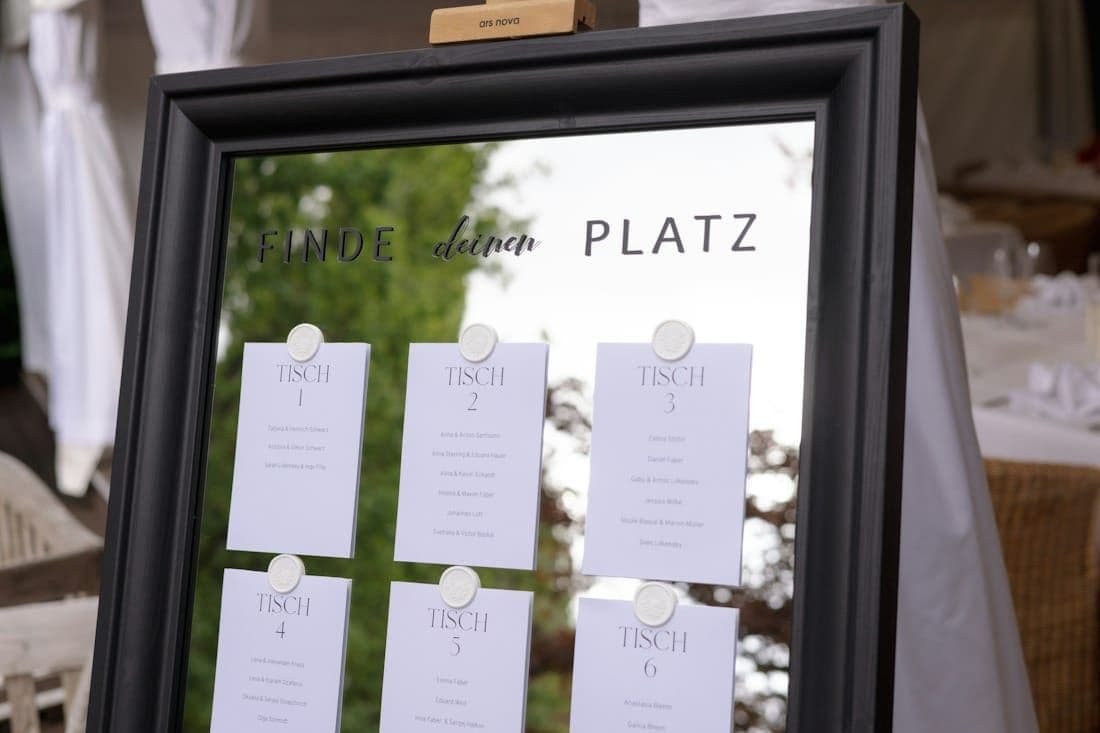
A wedding seating chart with table cards on a mirror
On this page
  1. When to Start Your Wedding Seating Chart
  2. How Many Tables Do You Need, and What Size?
  3. Who Sits Where at a Wedding Reception: Group Guests First
  4. Top Table, Head Table or Sweetheart Table?
  5. Wedding Seating Etiquette for Parents, Including Divorced Parents
  6. Seating Kids, Singles and Awkward Relatives
  7. Older Guests, Accessibility and Vendor Meals
  8. Wedding Seating Chart Template: Sample Plan for 80 Guests
  9. Wedding Seating Chart Sign Ideas and Wording
  10. How Occavia's Seating Plan Helps
  11. Handling Last-Minute Seating Changes
  12. Frequently asked questions

When to Start Your Wedding Seating Chart

Start the real seating chart once your RSVP deadline has passed, which for most weddings is three to four weeks before the day. Before that you're guessing, and every late "sorry, we can't make it" leaves a gap you have to reshuffle around.

You can still get ahead early. While replies come in, sort your guest list into rough groups and note which groups belong near each other. When the deadline passes, send a friendly nudge to anyone who hasn't answered, then build the chart properly. If replies are still arriving by text, email and phone call, it helps to collect RSVPs online so every answer lands in one place.

Aim to have the chart finished one to two weeks before the wedding. That's usually when your venue or caterer wants final numbers, and a printed sign needs time to be made.

How Many Tables Do You Need, and What Size?

Ask your venue two things first: which table sizes they have, and how many fit the room once the dance floor is in. They know the space better than anyone.

As a rough guide:

  • A 5-foot (150 cm) round table seats 8 comfortably, 10 at a squeeze
  • A 6-foot (180 cm) round table seats 10, sometimes 12
  • Long banquet tables need about 2 feet (60 cm) of width per person

To get your table count, divide your confirmed guests by the seats per table and round up. Then build in a little slack: a spare seat or two across the room makes last-minute changes painless. Even numbers per table work best, because most guests arrive as couples. Mixing table sizes is fine too, and it's often the easiest way to keep a big friend group together.

Who Sits Where at a Wedding Reception: Group Guests First

Don't start by filling Table 1. Start with your wedding guest list and sort everyone into groups: each side's close family, extended family, school friends, university friends, colleagues, your parents' friends, neighbours. Couples and plus-ones always stay together.

Next, match groups to table sizes. A group of eight is one table. A group of twelve can split across two tables, each topped up with a smaller group that has something in common with them: the running club with the gym friends, the cousins with the younger colleagues. Try to give every guest at least two or three people they know at their table.

Finally, place the tables in the room. Closest to you: parents, grandparents and the wedding party. The middle: aunts, uncles, cousins and close friends. Further out: colleagues and people you see less often. Sticky notes on a sheet of paper, or a simple spreadsheet, are all you need at this stage.

Top Table, Head Table or Sweetheart Table?

Your own table comes first, and there are three common options.

The traditional UK top table is a long table facing the room. Reading left to right as guests look at it: chief bridesmaid, groom's father, bride's mother, groom, bride, bride's father, groom's mother, best man. It looks elegant, but it gets tricky with divorced or remarried parents, and it separates the wedding party from their partners.

An American-style head table seats the couple with the wedding party in a line facing guests, often without dates.

A sweetheart table is just the two of you. It's the easiest option when family is complicated, it gives you a few quiet minutes together, and it lets your parents host their own tables and your wedding party sit with their partners right beside you.

Whichever you choose, put it where everyone can see you and close to where the speeches will happen.

Wedding Seating Etiquette for Parents, Including Divorced Parents

Parents usually sit at the tables closest to yours, or at the top table if you've gone traditional. The simplest setup is one table per family: each set of parents hosts their own table with grandparents, siblings and anyone else they'd want nearby, such as the officiant and their partner.

With divorced parents, the goal is that nobody feels demoted. Give each parent their own table, both equally close to yours, with their current partner and their side of the family. Don't seat exes side by side unless they are genuinely comfortable together, and ask each of them privately rather than guessing. A stepparent who helped raise you deserves the same honour as any parent.

If a parent is coming alone, surround them with the people they're most at ease with, like a sibling, an old friend or a grandparent, rather than filling the gaps with strangers.

Seating Kids, Singles and Awkward Relatives

Kids: babies and toddlers sit with their parents, ideally near an exit for quick escapes. Children from about seven up often love a kids' table, as long as it's close to their parents and has something to keep them busy, like colouring sheets or a small game. Teenagers usually prefer sitting with cousins over a kids' table.

Singles: skip the "singles table". It sounds fun on paper and rarely is. Seat single guests with friends they already know or with people who share their interests, and try not to leave anyone as the only person on their own at a table full of couples.

Awkward relatives: two people who don't get along sit at different tables, ideally not facing each other across the room. Distance isn't an insult; it protects your day. And a guest who knows nobody, like a cousin's new partner, sits beside the person who brought them, at the friendliest table you have.

Older Guests, Accessibility and Vendor Meals

Seat grandparents and older guests where they can see you and hear the speeches, but away from the speakers, band or DJ. Being near an exit and the toilets helps too. Guests who use a wheelchair or walker need a table at the edge with a clear route and room to pull up, not a spot wedged between other tables. Pregnant guests and anyone with a health condition will also appreciate an easy way out.

Don't forget your vendors. Your photographer, videographer, planner and band or DJ work a long day, and many contracts include a meal. Count them in your catering numbers, ask your venue where they'd like them seated, and arrange for them to eat at the same time as guests, so your photographer is free again when the speeches start.

Wedding Seating Chart Template: Sample Plan for 80 Guests

Here's a sample for Emma and James: 80 people in total, a sweetheart table, and James's parents are divorced. Use it as a template and swap in your own groups.

  • Sweetheart table: Emma and James (2)
  • Table 1, Emma's family: her parents, grandparents, aunt and uncle, the officiant and partner (8)
  • Table 2, James's mum's side: his mother and stepfather, her parents, his godparents, two cousins (8)
  • Table 3, James's dad's side: his father and partner, his uncle and aunt, their four grown-up children (8)
  • Table 4, wedding party: maid of honour, best man, bridesmaids, groomsmen and their partners (10)
  • Table 5: university friends (10)
  • Table 6: colleagues from both jobs (8)
  • Table 7: parents' friends and neighbours (8)
  • Table 8: more cousins and their partners (8)
  • Table 9: families with young children, near the exit (10)
  • Vendor table, not counted in the 80: photographer, videographer, planner, DJ

Tables 1, 2 and 3 sit closest to the sweetheart table, with Tables 2 and 3 on opposite sides so both of James's parents are equally close.

Wedding Seating Chart Sign Ideas and Wording

However you display it, list guests alphabetically by surname with their table next to each name. People scan for their own name, not for a table, and an alphabetical list stops a queue forming at the door. For a big wedding, split the list across two boards.

Popular ways to show it:

  • A seating chart sign or board on an easel at the entrance to the reception room
  • A large mirror or window, written on with a paint pen
  • Escort cards: one small card per guest showing their table, laid out alphabetically
  • Place cards at each seat, only needed if you assign exact seats, for example for a plated dinner with meal choices
  • A QR code sign guests scan to look up their table on their phone

Named tables (cities, songs, places you've travelled to together) look lovely; just check that each name on the sign matches the card on the table.

Copy-paste wording for a classic board: Welcome to our wedding Find your name, and your table is right beside it [Names] · [Date]

For a QR code sign: Find your table Scan the code and type your name Then come and eat, drink and dance with us

How Occavia's Seating Plan Helps

If your invitations are on Occavia, your event dashboard has a Seating plan page. You create tables by name, such as "Table 1" or "Family", each with a seat count (8 by default), and you can rename, resize, reorder or delete them; deleting a table keeps its guests, who simply become unseated. Your guest list can be imported from Excel, Google Sheets, Numbers or a CSV file, or pasted in. Then give each party a table from a dropdown, or select several and assign them in one go. Filters show who's still unseated and who's at each table, with counts like 6/8, and any table over capacity is highlighted.

Seat counts follow your online RSVPs: a party counts its invited size until it replies, its confirmed size once it says yes, and frees its seats when it declines, with each party's status shown beside it. It's a table list rather than a drawn floor plan, so agree the room layout with your venue.

Then there's Find your seat, which stays off until you switch it on. Guests type their name (at least three letters) and see their table name, with no app or account needed. Share the lookup link or put it on a screen, download the QR code, or print a ready-made A4 poster from your browser in one of three designs: Navy & gold, Wine classic or Cream elegant. Guests who have replied yes on their phone can also find their table on the digital wedding invitation itself.

Two tips: enter names the way guests will type them, because the search doesn't correct typos, and tell plus-ones to search under the main guest's name. A partner, parent or planner you invite as a co-host can help with tables and assignments too.

Handling Last-Minute Seating Changes

Something will change in the final week: a late decline, a surprise plus-one, a couple who have split up. Don't redo the whole chart. Fill the gap from the same group, use the spare seats you left, or move one small group rather than several individuals.

Choose one person to keep the final version, send it to your venue coordinator, and print signs and escort cards as late as you can. Keep a few blank cards and a pen on hand for surprises. If guests look up their table on Occavia, any change you make shows up for them straight away, which is a relief when the printed board is already on its easel.

Frequently asked questions

When should you make a wedding seating chart?

Start the final chart once your RSVP deadline has passed, usually three to four weeks before the wedding, and aim to finish it one to two weeks before, so your venue has final numbers and any signs can be printed. You can sort guests into rough groups much earlier, while replies are still coming in, which makes the final version far quicker to put together.

Do you need a seating chart for a wedding?

For a sit-down meal, yes: a seating chart avoids a scramble for chairs, keeps families together and makes serving much smoother. For a small, relaxed wedding or a buffet with plenty of seating, open seating can work, but it's still kind to reserve tables for parents, grandparents and anyone with mobility needs, so they're not left hunting for a chair.

Where do divorced parents sit at a wedding reception?

Usually at separate tables, each hosting their own side of the family with their current partner, and both placed equally close to the couple. With divorced parents, a sweetheart table is often simpler than a top table, because nobody has to share a line of seats with an ex. Ask each parent privately what they'd be comfortable with rather than assuming.

Should a wedding seating chart be alphabetical or by table?

Alphabetical by surname, with the table number or name next to each guest. Guests look for their own name, not for a table, so an alphabetical list gets everyone seated faster and stops a crowd forming around the sign. Listing by table looks pretty, but it makes every guest read every table until they spot themselves.

Is there a wedding seating chart app or online tool?

Several tools can help. If you send your invitations with Occavia, its seating plan lets you create tables, seat the parties on your guest list and see seat counts update as RSVPs come in. With the optional Find your seat switch on, guests type their name and see their table from a QR code, a shared link or their invitation, with nothing to download.

How many guests should sit at each wedding table?

Most round wedding tables seat 8 to 10 people, depending on their size, and even numbers work best because guests often come as couples. Avoid squeezing in extra chairs: guests need elbow room, and servers need to reach every plate. Leaving a spare seat here and there also gives you room for last-minute changes.

Create your invitation